
A shower is the fixture people leave the longest. A slow kitchen sink gets dealt with the same week, but a shower that takes a minute to drain after you get out is easy to live with, until the day you are standing ankle-deep in it. By then the thing causing it has usually been building for months.
The good news is that a shower is also the fixture where the blockage sits closest to the surface. Nearly all of them are within arm’s reach. The trick is knowing that, and knowing the point at which reaching further stops helping and starts costing money.
This guide is about showers specifically. If more than one drain in the house is slow, or you are not sure yet which fixture is the problem, start with how to clear a blocked drain instead: it covers the diagnosis across the whole house and what works on each fixture.
Is the shower actually blocked?
Start here, because a surprising number of “blocked” showers are not blocked at all, and the three checks below take about two minutes between them. They also decide whether this is a job for your hands or a job for a machine.
Check one: how many fixtures are slow?
Run the bathroom basin, then the bath if there is one, then flush the toilet. In most Australian bathrooms the shower, the basin and the bath all feed the same branch line before it joins anything else.
- Only the shower is slow. The blockage is between the grate and where that waste joins the branch: a run of maybe a metre. This is the one worth doing yourself.
- The basin or the bath is slow too. The blockage is downstream of all of them. Nothing you do at the shower grate will reach it, no matter how much hair you pull out.
- The toilet is affected as well, or the floor waste is backing up. That is the main sewer line, not the bathroom. Stop.
That distinction is the first question we ask on the phone, and it is the difference between a twenty-minute clear and a camera going down the line. It is also why the advice you find for blocked drains in Vaucluse starts with diagnosis rather than a shopping list.
Check two: where does the water actually sit?
Watch the shower while it runs, then turn it off and look at where the water pools. This one almost nobody mentions and it changes the answer completely.
If the water backs up over the waste and drains away slowly, the drain is restricted. That is a blockage. If the water sits in a corner or along one edge and the area around the waste is nearly dry, the drain is fine: the fall of the floor is wrong. Tiled shower bases are laid on a screed that should fall evenly to the waste, and where that screed has been laid flat, or has moved, water collects at the low point instead.
Check three: does anything gurgle?
Fill the basin, pull the plug, and listen at the shower waste. A gurgle means air is being dragged back through the water seal in the shower trap because it cannot move through the pipe. Two fixtures talking to each other like that is a restricted shared line, and again, it is not something you fix at the grate.
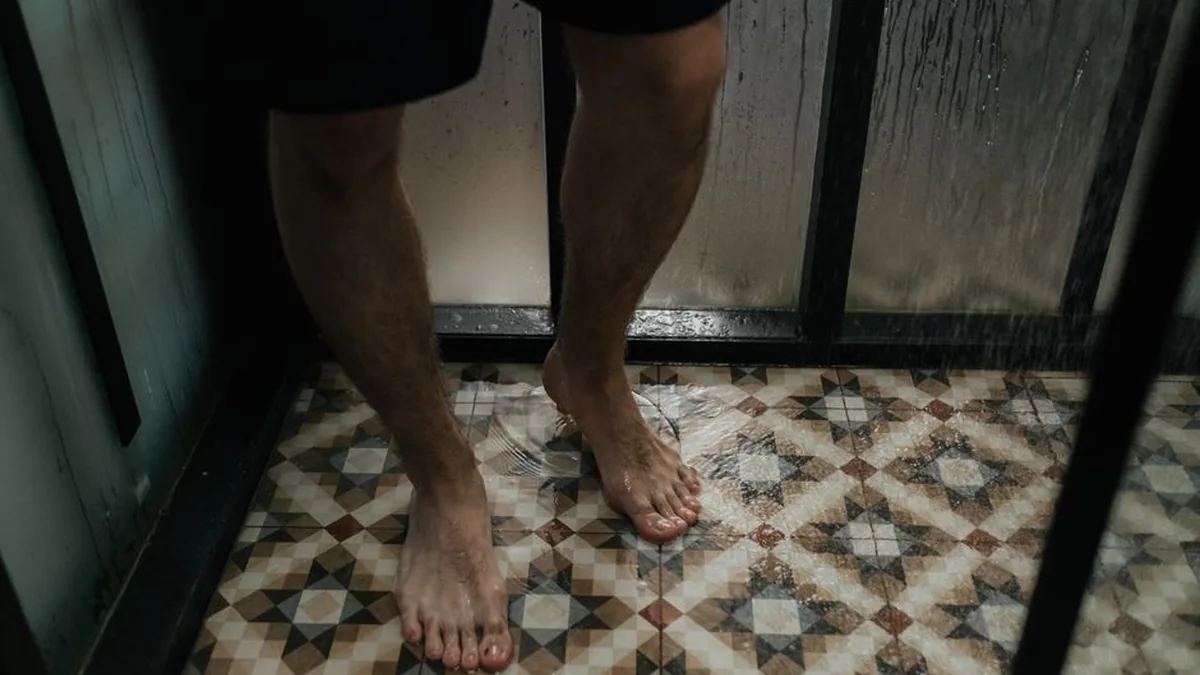
What blocks a shower drain, and where it sits
Four things, in order of how often we pull them out. What matters as much as what it is, is how far down it sits, because that decides who can reach it.
Hair and soap scum: the rope in the first 150 millimetres
This is the overwhelming majority of them. Hair does not block a drain on its own; it catches on the underside of the grate and on the rough edge of the waste, and then soap scum binds it into something with the density of felt. Pulled out whole, it comes up as a rope, and its top is usually 50 to 150 millimetres below the grate.
That is the number worth remembering. It means the blockage is almost always inside the reach of a gloved hand, and it means the products sold to pour on top of it are being poured onto something you could have picked up.

Soap scum, and why Sydney water makes it worse
Soap scum is not dirt, it is a chemical reaction. The fatty acids in soap combine with calcium and magnesium in the water to form calcium stearate: the grey film on the shower screen is the same stuff. It is not water-soluble, which is why rinsing does not remove it, and it sets hard against the inside of a waste pipe.
Sydney’s supply is soft to moderately hard by world standards, so this is slower here than in Adelaide or Perth, but bar soap produces far more of it than liquid body wash does, and older copper and earthenware wastes have a rougher internal surface for it to grip. In a bathroom that has been in use since the 1950s with an original waste, the pipe can be measurably narrower than it was.
Sand, and why it is an Eastern Suburbs problem
This one is genuinely local, and it behaves differently to everything else. Between Camp Cove, Nielsen Park, Parsley Bay and the ocean beaches a short drive away, a lot of showers around here are the first stop after the sand. Rinse it off and it goes down the waste.
Sand does not float and it does not bind: it settles. It drops out of suspension at the first point where the water slows, which is the bend under the floor, and it sits there as a heavy layer that water still runs over. That is why a sandy shower goes slow gradually rather than blocking suddenly, and it is why plunging it achieves nothing: a plunger moves water back and forth, and sand simply resettles in the same place.
The tool for sand is suction, not pressure. A wet-and-dry vacuum held over the open waste will lift a surprising amount of it. Beyond what that reaches, it needs flushing out with water volume, which is a jetter’s job.
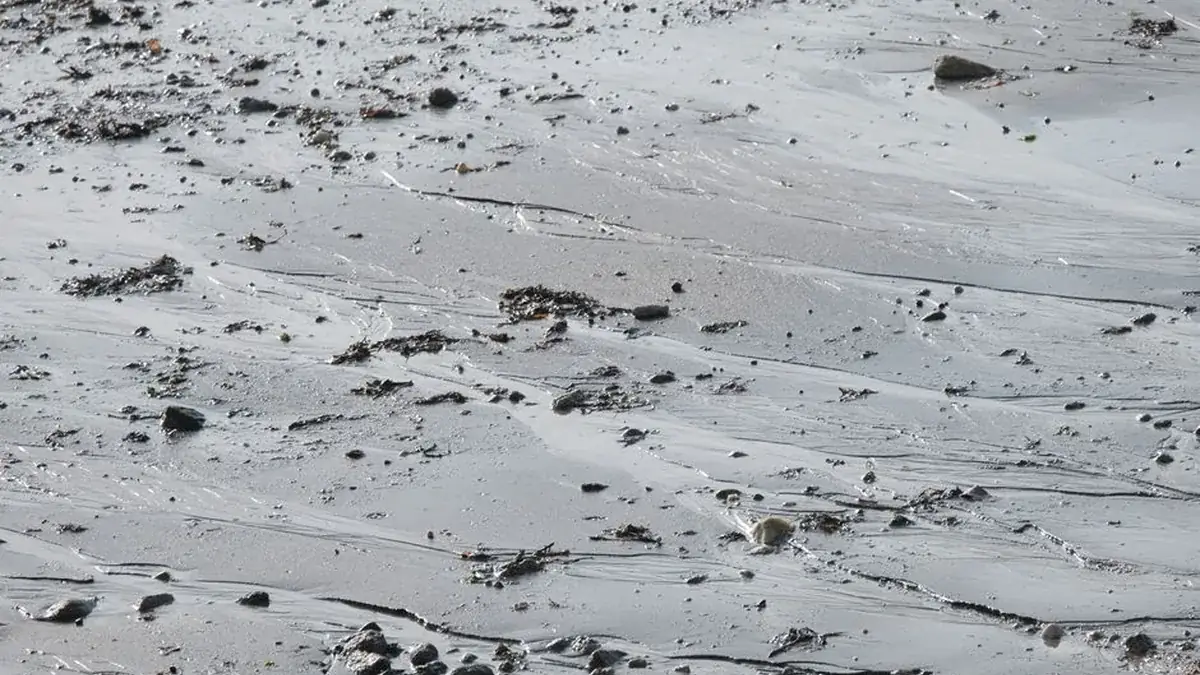
Scale and the condition of the pipe itself
Last, and least fixable at home: the pipe has narrowed. Mineral scale, decades of scum, or a section of original earthenware with a rough or displaced joint. Nothing is blocking it in the sense of an object sitting in the way: the bore is simply smaller than it was, so it carries less, and anything that goes down catches.
The tell is a shower that has been getting slower for years rather than months, and that goes slow again within weeks of being cleared. That is not a blockage you clear, it is a pipe you deal with.
The one thing that makes a shower different from a sink
Almost every guide to unblocking a shower drain is a guide to unblocking a sink with the word changed, and there is one point where that falls over badly: you cannot take a shower’s trap apart.
Under a basin or a kitchen sink there is a U-bend with two hand-tight collars, sitting in a cupboard. Undo them over a bucket and you have direct access to the single most common blockage point in the house. That is why “clean the P-trap” is the best advice on any sink page.
A shower has no such thing. Depending on how the bathroom was built, what is under the grate is either a shallow trap cast into a concrete slab, or a puddle flange and a bend in the joists under a timber floor, or on many older Sydney bathrooms a floor waste that also drains the room. In every one of those cases the trap is behind tile, screed or floor. There is nothing to unscrew, there is no bucket, and there is no inspection point.
How to unblock a shower drain
Four methods, in the order worth trying them. Between the first two you will clear the large majority of shower blockages.
1. Clear the base and lift the grate off
Bail the standing water out first: a jug and a towel, or a wet-and-dry vacuum. You cannot work through 40 millimetres of grey water and you cannot see what you are doing.
Then get the grate off. Most square chrome shower grates lift straight out once you get a flat screwdriver or a butter knife under the lip. Some have a single screw in the centre, occasionally a Phillips head painted over. Older round brass ones sometimes thread in and turn out anticlockwise. Lift it, do not lever hard against the tile: the edge of a tile chips more easily than the grate moves.
2. Pull the hair rope out
Gloves on, and reach in. What you are looking for is a mat sitting on the ledge just inside the waste, or caught around the cross-bar if there is one. It will not feel like much until it starts coming, and then it usually keeps coming.
Run the shower for thirty seconds afterwards and watch. If it drains at full speed, you are done, and that is the outcome on most of them. If it is better but still not right, go to the next step. If nothing changed at all, go back and re-read the three checks above: a fixture that is unchanged after the grate is clear was probably never the fixture with the problem.
3. A barbed plastic drain tool, or a small hand auger
The five-dollar barbed plastic strip sold for exactly this job is the right tool and it is better than it looks: it goes about 450 millimetres, the barbs face backwards so they grip hair on the way out, and being plastic it will not scratch the pipe. Feed it in, twist it a quarter turn, and draw it back slowly rather than yanking.
A small hand auger, a coiled spring with a handle, reaches a bit further and is fine on a shower waste used gently. Turn the handle when you feel resistance and let the coil work. The moment you find yourself pushing with your shoulder, stop: that is the bend under the floor you are pushing against, not the blockage.
4. One proper plunge, or a vacuum for sand
With the grate off, run enough water to cover the plunger cup completely: a plunger moves water, not air. Push and pull firmly for about twenty seconds. A shower has no overflow to block, which makes this easier than a basin, but a flat tiled base seals less well than a moulded one, so press the rim down hard.
Have one honest go. If the water has not moved, stop rather than repeating, on a blockage that is not shifting, repeated plunging compacts it further along the pipe instead of breaking it up.
If you suspect sand, skip the plunger entirely and put a wet-and-dry vacuum over the open waste on the wet setting. Suction lifts settled grit; pressure just moves it around and lets it settle again.
How do I get rid of standing water in my shower?
Bail it, do not wait for it. A jug or a plastic cup into a bucket clears a shower base in a couple of minutes, and a wet-and-dry vacuum does it in well under a minute. Finish with an old towel so the base is dry enough to see and work on.
Two reasons not to leave it sitting. The obvious one is that you cannot get the grate off or judge whether anything you have done worked. The less obvious one is that standing water on a bathroom floor eventually finds the weakest point in the waterproofing, usually the junction at the shower door or the perimeter grout, and what starts as an inconvenience becomes a damp wall in the next room.
Four things that make a blocked shower worse
Each of these comes up on jobs regularly, and each one turns a straightforward clear into a bigger bill.
- Boiling water. Covered just below, and it is the single most repeated bad tip on this topic.
- Caustic drain cleaners. They generate heat sitting against one spot in the pipe, they rarely move a hair rope, and they turn the water in the shower base into something genuinely hazardous. If it does not work, the next person to put a hand in that waste, you or us, is reaching into caustic soda.
- A wire coat hanger. It scratches the inside of the waste, and every scratch is somewhere the next lot of hair catches. On a chrome waste it also marks the visible part, which is annoying rather than expensive, but it is permanent.
- Forcing an auger past the bend. A shower waste turns within 100 to 200 millimetres of the grate. Driving a long auger into that turn means working blind against the tightest point in the run.
Baking soda, vinegar and boiling water on a shower
None of the three do anything to a hair rope. The general reasons why — the chemistry, and what a kettle does to a PVC joint — are set out in our guide to clearing a blocked drain. What is different about a shower is narrower, and it is the part nobody covers.
Hair is keratin. A weak acid and a weak base do nothing to it whatsoever, so on a shower the bicarb-and-vinegar trick is even less use than it is on a sink, where at least there is soap film for it to loosen. Boiling water has the same problem in reverse: it helps against congealed fat, which is a kitchen blockage. Hair and calcium stearate do not melt.
Then there is the risk that only exists here. A shower base with standing water in it is something you are leaning over barefoot. Tipping a full kettle into a puddle at floor level is not a risk worth taking for a method that was never going to work. Hot from the tap with a squirt of dishwashing liquid does everything the kettle would have done to soap scum, and none of the damage.
What will dissolve hair in a drain?
Nothing you can buy, reliably. It is worth explaining why, because this is where most of the money spent on blocked showers goes and almost none of it works.
The products sold for hair are strong bases, sodium hydroxide, usually with sodium hypochlorite. Given hours of contact in hot standing water they will break down part of a hair mat, which is why they appear to work in a laboratory photograph. In an actual shower waste the water drains past the blockage rather than sitting on it, contact time is minutes at best, and the hair rope is bound with calcium stearate which the product has to get through first.
What those products reliably do achieve: soften PVC joints, attack the glaze on old earthenware, and leave a waste full of concentrated caustic soda for whoever opens it next. Hair comes out mechanically or it does not come out. That is the honest answer and it is also the cheapest one: a five-dollar plastic strip beats a fifteen-dollar bottle every time.
Four signs the problem is not in the shower at all
Any one of these means the shower is a symptom and the cause is further down. They are worth knowing because they save you an afternoon of pulling at a grate that was never the problem.
- The basin, bath or laundry tub is slow as well. Shared line, blockage downstream of all of them.
- The shower gurgles when the washing machine drains or the toilet flushes. Air being pulled back through the water seal because it cannot move through the pipe.
- It goes slow again within weeks of being cleared. Something in the line is catching debris: a root at a joint, a section holding water, or a narrowed old pipe. Clearing it again just restarts the clock.
- It is worse after heavy rain. Stormwater getting into a cracked sewer overloads the line. The slow shower is the symptom; the crack is the problem.
Why shower drains block the way they do around Vaucluse
Three local factors, and they compound.
The first is the age of the pipework. A good deal of the housing stock here predates PVC, which means original earthenware running in short sections with mortared joints. Those joints were never watertight the way a modern pipe is, and a tree root only needs a seam of moisture to find its way in. The mature figs, camphor laurels and paperbarks that make these streets what they are have had fifty or sixty years to work along the line.
The second is the renovation history. Bathrooms here have been redone two and three times, and a shower waste that was re-routed to suit a new layout is often the shallowest, flattest run in the house. Where a section runs level or backfalls slightly, water sits in it and everything that goes down settles there.
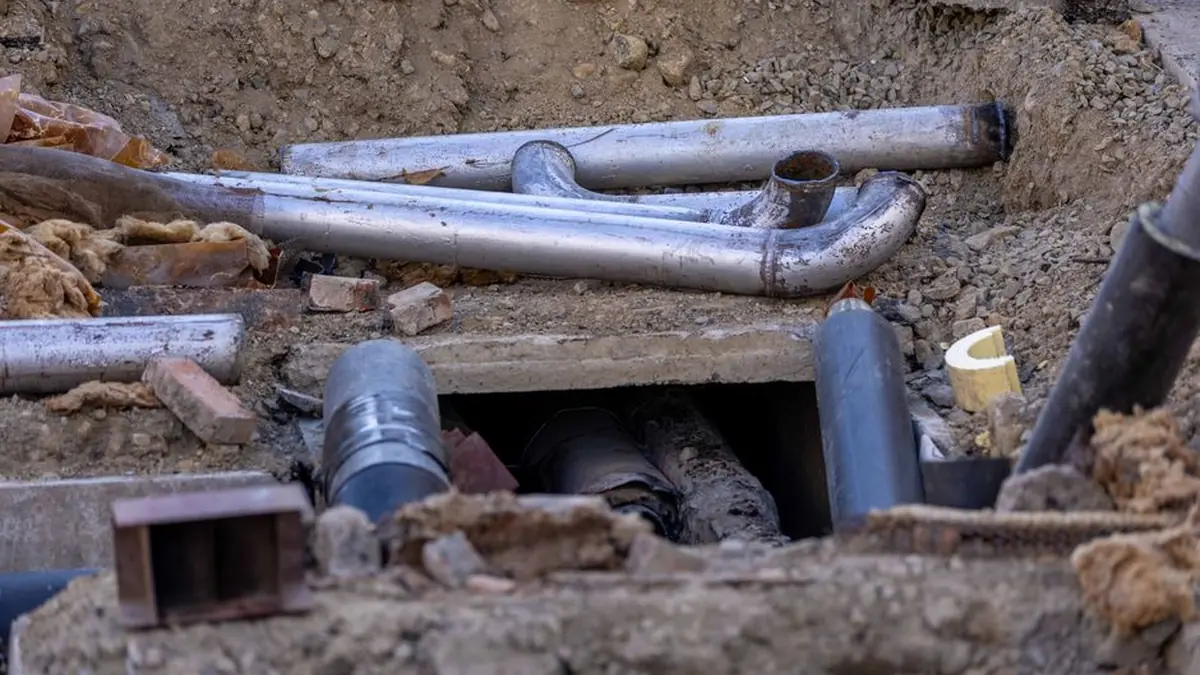
The third is the sand, which is the one that surprises people. Between the harbour beaches and the ocean, showers around here handle more sand and grit than showers four suburbs inland, and it accumulates at exactly the flat spot the renovation created.
None of that is fixed by clearing the blockage. It is fixed by finding out which of the three it is, which is why a camera goes down any shower waste that has blocked more than once. Where the footage shows a cracked or root-damaged section, relining that length ends the cycle without digging up a tiled floor, and on the recurring ones, that is what blocked drain repairs in Vaucluse actually means in practice.
What a plumber actually does with a blocked shower
Worth knowing so you can tell whether what is being proposed is reasonable, and so the visit is not a mystery.
- The same three checks you just did. Which fixtures, where the water sits, what gurgles. If someone starts machinery without asking those, that is a flag.
- The grate comes off and the top of the waste gets cleared. On a lot of jobs this is the whole visit, and it should be priced like it.
- A small electric eel through the waste. A flexible cable with a cutting head, driven from a machine rather than by hand, which reaches the bend and the branch beyond it. This is what clears a hair or scum blockage past arm’s reach.
- A camera, if it has blocked before. A self-levelling head on a reel, with a locator, so the actual fault is found and its depth and distance marked on the surface. This is the step that stops the same job recurring.
- A high-pressure jetter, on scum, sand or scale. Water at around 4,000 PSI scours the full diameter of the pipe rather than punching a hole through the middle of the blockage, which is why a jetted line stays clear longer than an eeled one.
How to stop it happening again
Only the parts that change outcomes. Most of what we clear out of showers was preventable by one of these.
- Put a hair catcher over the waste. A three-dollar silicone or mesh insert stops nearly everything described on this page. It is by a wide margin the highest-return item here, and it is the one thing most bathrooms do not have.
- Pull the grate and clear it every few months. Thirty seconds, and it is the difference between a rope and a strand.
- Rinse the sand off outside. A garden tap and a bucket before anyone comes inside. Obvious, and it removes the local factor entirely.
- Switch bar soap for liquid body wash. Far less calcium stearate, which is what binds the hair into something solid in the first place.
- Run a rarely-used shower for thirty seconds a month. It keeps the water seal full, which is what stops sewer smells in a guest bathroom.
- After the second blockage, stop clearing and start looking. Two in a year is a pipe telling you something. A camera inspection costs less than the third and fourth call-outs combined.
The last one is the only real money-saver on the list. Clearing the same waste three times in a year is not maintenance: it is paying for the same job repeatedly and never touching the thing causing it.
When a blocked shower is worth calling about tonight
Most blocked showers can wait until morning, and we will say so on the phone rather than charge after-hours rates for something that is not moving anyway. Call it in straight away if:
- Sewage or grey water is coming up through the shower waste, a floor waste or an outside gully: that is the line backing up, not the shower blocking.
- Water is escaping the recess and running across the bathroom floor while anything is draining.
- A washing machine or dishwasher is mid-cycle and the shower is filling: the pump will keep going regardless.
- You can smell sewer gas indoors and running the shower does not clear it.
The first one especially. A gully overflowing outside is doing its job: it is a relief point, and it is telling you the main line is blocked rather than the fixture. Grey water coming up inside the house is a different matter and worth an after-hours callout.
Short of that, the honest advice is the same as it was at the top: get the grate off, clear the first 150 millimetres, and if it still will not go, stop there. A shower has no trap to undo, and everything past that point needs a machine.