
Almost every guide to a blocked stormwater drain is a blocked sewer guide with the words swapped, and it shows: they open with the drain being a mystery under your feet, then reach for a plunger, a bottle of drain cleaner or a kettle. None of that belongs here.
Stormwater is the only drain on your property that you can follow almost end to end without lifting anything. It starts in a gutter you can see from the footpath, runs down a pipe bolted to the outside of your wall, disappears at ground level for a few metres, and comes back out at the kerb where you can watch it. The blockage is nearly always in a section you can point at, and a garden hose will tell you which one.
It also runs to a completely different place than your sewer does, which changes what you are allowed to put in it, who is responsible for it, and what it means when it fails. That is where this has to start.
Stormwater is not your sewer, and the difference decides everything
Two entirely separate pipe systems run under a normal Sydney property, and mixing them up is the single most common reason people spend money in the wrong place.
Where each one goes
The sewer takes everything from inside the house: toilets, showers, sinks, the laundry. It runs into Sydney Water's network and on to a treatment plant. It is under pressure of habit rather than weather, so it runs every day at roughly the same rate.
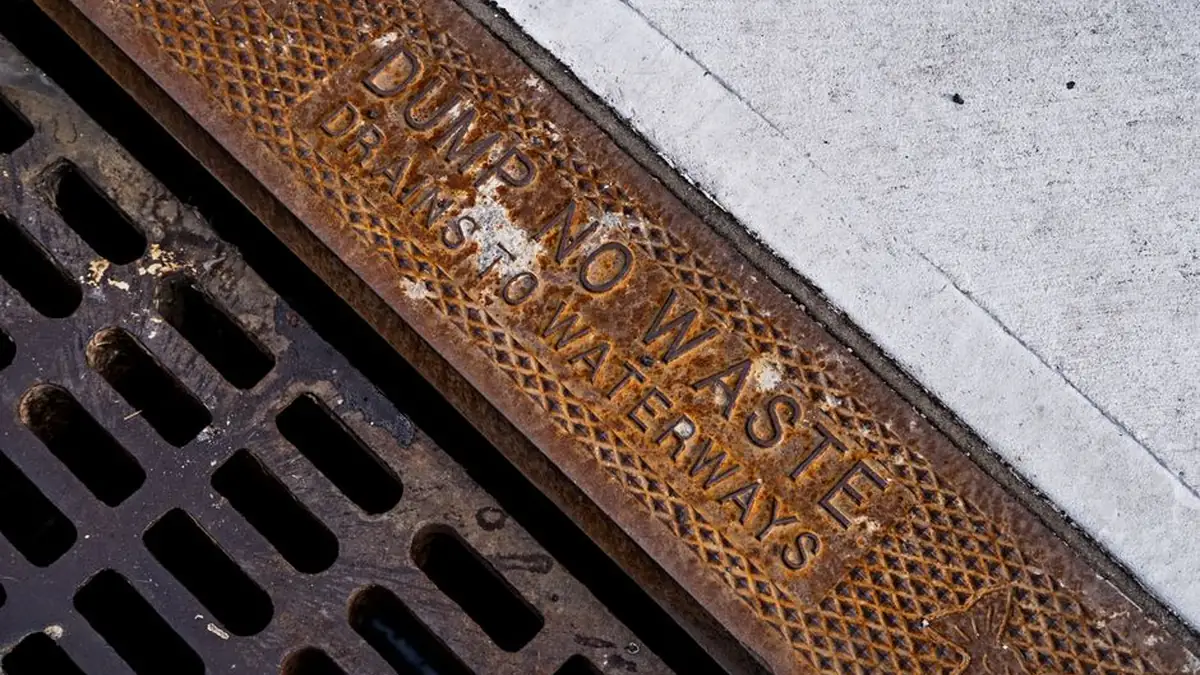
Stormwater takes rain, and only rain. Roof water off your gutters, surface water off paving and lawn, and on some properties the overflow from a rainwater tank. It is not treated. It runs to a creek, a canal or straight into the harbour, in the same condition it left your roof in. Around here that outfall is often only a few hundred metres away, which is why the grates on the street are frequently cast with a line about draining to waterways. The cast lettering is not decoration; it is there because the pipe genuinely ends in the water people swim in.
Two questions that tell you which system has failed
You can usually settle this from your own back step, and it takes about a minute.
- Does it only happen when it rains? If the problem appears in a downpour and is gone an hour after the rain stops, it is stormwater. A sewer blockage does not care about the weather, because the water going into it comes out of your taps.
- Does it smell? Stormwater smells of wet leaves and mud at worst. If there is a sewage smell, or if a toilet is gurgling when the shower runs, that is the other system and this is the wrong article.
The awkward middle case is a yard that floods only in storms and smells. That usually means the two systems are connected somewhere they should not be, which is a real thing and worth taking seriously. On older properties it is normally an illegal connection made during a renovation: a downpipe plumbed into the sewer, or a gully connected into the stormwater line. Either way it is a job for someone with a camera rather than a shovel.
Never pour anything into a stormwater drain
This is the one point where the ranking pages on this topic are not merely unhelpful but wrong, and it is worth being blunt about. The most detailed DIY guide currently on page one lists drain cleaning chemicals in its equipment section, alongside a plunger and a broom.
Do not. In New South Wales, the Protection of the Environment Operations Act 1997 makes it an offence to pollute waters, and a stormwater drain is waters for that purpose because there is nothing between it and the harbour. That covers drain cleaner, paint, solvents, engine oil, pool backwash, sugar soap off a render job, and the bucket of grey water somebody tips down the yard grate because it is closer than the laundry tub. This is not a technicality that nobody enforces either. Councils issue fines for it, and the eastern beaches and harbour swimming spots are precisely where the consequences turn up.
The practical argument lands in the same place. Caustic drain cleaner is formulated to attack fat and hair, which is what blocks a sewer. A stormwater blockage is leaves, silt, sand, roots and grit. There is no chemistry there for it to work on. Pouring a bottle of it into a pit achieves nothing except a pit full of caustic water that someone, quite possibly you, has to put a hand into afterwards.
What a blocked stormwater drain actually looks like
This system gives you no warning of the kind you get from a sewer. There is no gurgle, no smell, no slow-draining fixture inside the house. A blocked stormwater drain has no symptom at all until it rains, which is why most of them are found by the damage rather than by the fault. These are the signs, roughly in the order they appear.
- A gutter that overflows along its length in a downpour. Worth watching carefully, because it can be either problem. See the next section.
- Water backing up out of the top of a downpipe, or spitting out at the joint where it meets the gutter. This one is unambiguous: the pipe below it cannot take what is coming down.
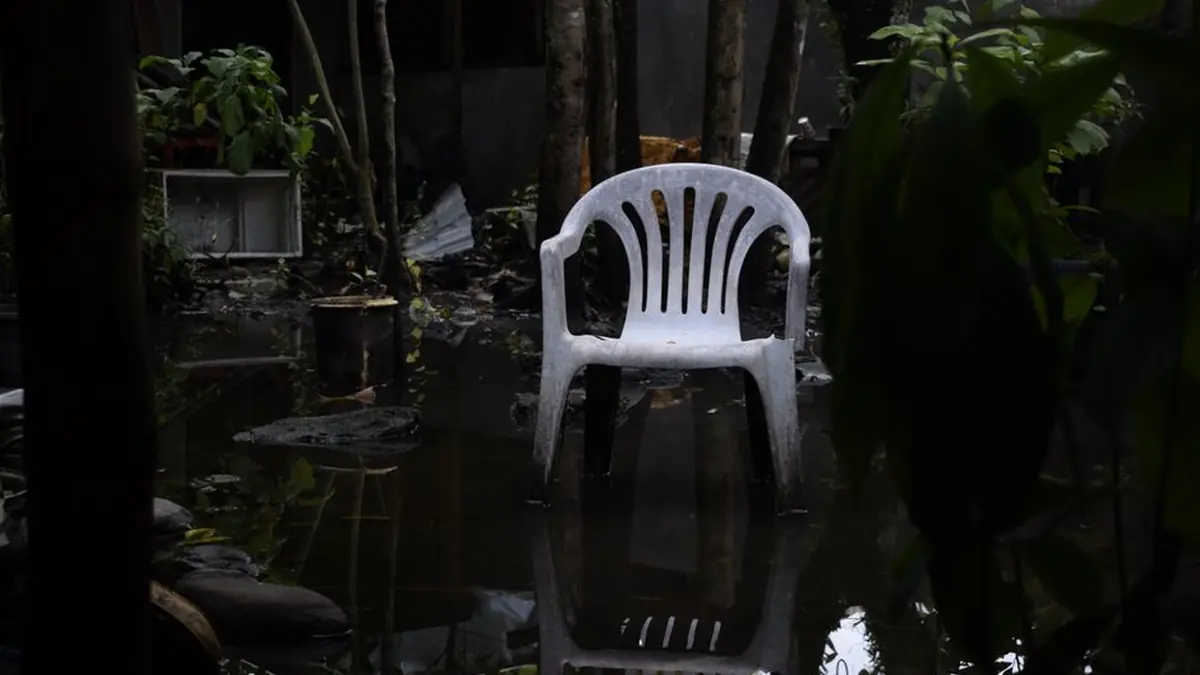
- Water rising out of a grate at ground level while it rains. A stormwater pit is meant to take water in, not push it out. If it is surcharging, the line downstream of it is restricted.
- Ground that stays wet for days after the rain stops. A lawn that is still spongy on Wednesday after Sunday's rain is holding water that should have left through a pipe.
- Damp appearing at the base of an external wall, or in the subfloor of a timber-floored house. This is the expensive one, and it is often the first sign anyone notices.
- Paving that has started to move, or ground that has gone soft in one spot. Water escaping a broken line washes the fill out from under whatever is above it. The surface holds up until it does not.
- A pit with standing water in it on a dry week. Sometimes a blockage, sometimes entirely normal, and the charged-line section below explains which.
Half of these calls are the gutter, not the drain
Worth its own heading, because it is the most common wasted call-out on this topic and it is free to rule out.
A gutter and a stormwater drain fail in ways that look almost identical from the ground: water everywhere, at the same time, in the same weather. They are different jobs. A gutter packed with leaf litter overflows over its front edge along its whole length, fairly evenly, and it does it even in moderate rain. A blocked drain backs water up at one point, a particular downpipe or a particular pit, while the rest of the run behaves.
So stand outside in the next decent shower and watch where the water leaves the system. Evenly, over the lip, everywhere: gutter. Rising up out of one specific opening: drain. That single observation decides whether the fix is a gutter clean or a drain clear, and those are not close in either method or price.

Learn the shape of your system before you touch it
Ten minutes of walking around the outside of the house is worth more here than any tool, because unlike a sewer, most of this is in plain sight.
What the path looks like
A typical Sydney property runs roof water through five stages, and you can put your hand on four of them.
- The gutter, catching the roof water and running it to the outlets.
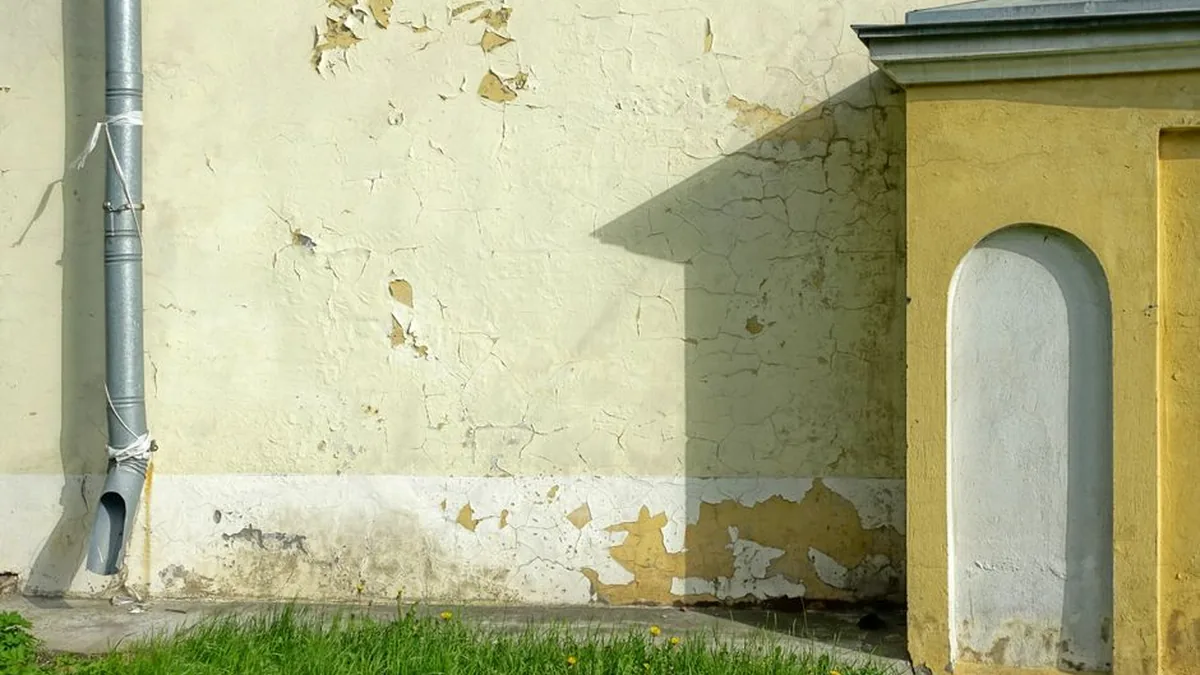
- The downpipe, taking it to the ground down the outside of a wall. Most are 100 by 50 millimetres rectangular or 90 millimetres round.
- The shoe, the bend at the bottom where the downpipe turns into the ground. On many houses this is a push fit that lifts straight off, and it is the single most accessible opening in the whole system.
- The underground line and its pits, usually 90 or 100 millimetre PVC on anything modern, earthenware on anything old, running from downpipe to downpipe and picking up any yard grates on the way.
- The outlet, which is either a hole through the face of the kerb at the front, a connection into a council line, an absorption trench, or on a low block a pump-out pit.
Find the outlet first. On most streets around here it is a rectangular hole in the kerb face, and if you look along the gutter on a dry day you can usually spot every property's. That is the finish line for everything below. If you genuinely cannot find one, the property may drain to an easement across a neighbouring block, an absorption trench, or a pump, and it is worth knowing that before you start rather than after.
Charged lines: the ones that are full of water on purpose
This catches people out constantly around here and no guide mentions it. Where a block falls away from the street, roof water sometimes has to be carried up to reach the outlet at the kerb. The way that is done is a charged line, also called a wet system: the pipe is sealed, it stays permanently full of water, and the head of water from the downpipe pushes it up and out through a riser at the far end.
It is not a fault. It is designed that way, it complies with the standard for stormwater drainage, and it is fairly common on the steeper blocks in this part of Sydney where the house sits below the road. But two things follow from it that matter to you.
First, if you open a charged system and find it full of water, that is what it is meant to look like. It is not proof of a blockage. Second, a pipe that holds water all year drops out anything heavy that gets into it, so charged lines silt up more readily than gravity ones. They are supposed to have a drain valve or a clearing point at the low end for exactly that reason, and on plenty of older installations that point has been paved over or was never fitted. If you have one of these and it has never been flushed, that is the thing to have looked at.
The hose test: find the blocked section in ten minutes
This is the method, and it is the reason it is worth understanding the layout first. You are not trying to clear anything yet. You are trying to turn "the stormwater is blocked" into "the run between the north-east downpipe and the front pit is blocked", which is a different conversation entirely, and one that saves money whether you fix it yourself or not.
1. Get the standing debris off the openings
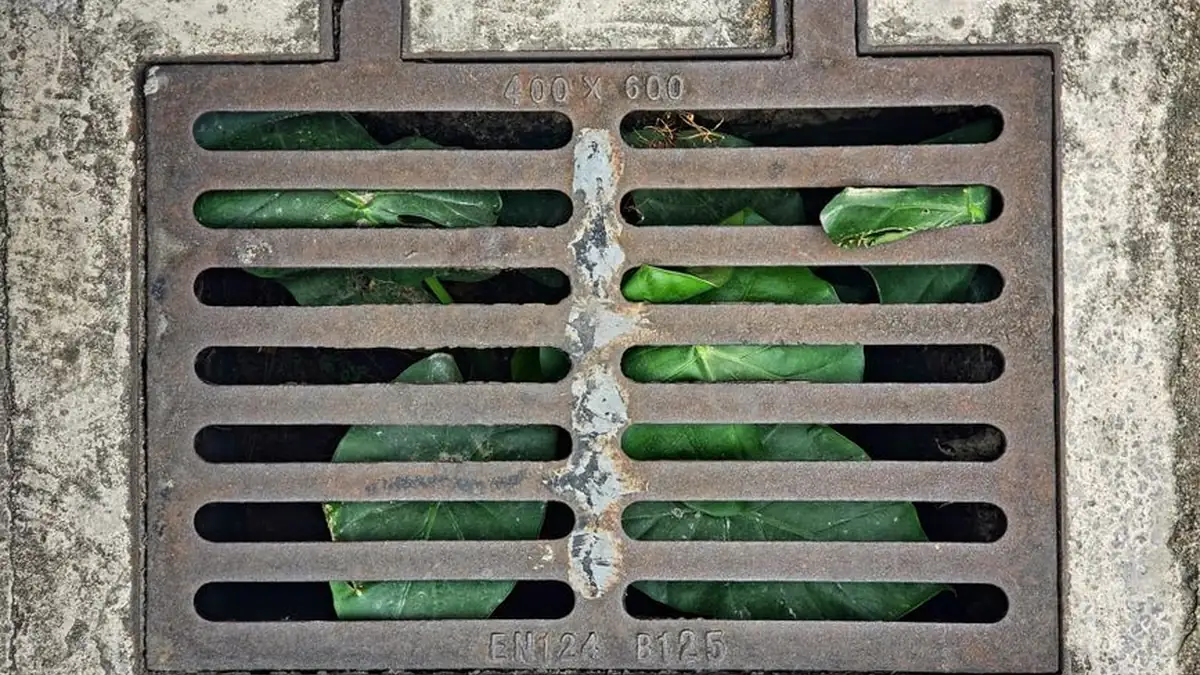
Before any testing, walk the property and clear what is on top of the grates. Leaf litter mats across a grate and stops water entering the pit at all, and clearing it by hand takes seconds. Do the same at the bottom of each downpipe: if the shoe lifts off, take it off and pull out what is sitting in the bend. It is usually a wad of leaves, roof grit and the odd tennis ball, and on a decent share of these that is the entire problem.
2. Run a hose into one downpipe at a time
One at a time is the whole point. Push the hose about 300 millimetres into the top of the downpipe at ground level, or into the pipe at the shoe if you have taken it off, turn the tap on hard and leave it a full minute. Then go and look at the outlet.
3. Read what happens
- Water arrives at the kerb outlet. That run is clear. Move to the next downpipe.
- Water backs up out of the downpipe. The blockage is below that downpipe, and you have just found which few metres of pipe matter.
- The hose disappears and nothing arrives anywhere. This is the one to take seriously. Water going in and not coming out means it is leaving the pipe somewhere in between, which means a break or a disconnected joint, and it is soaking into the ground next to whatever that pipe runs past.
- Water arrives at a pit part way along but not at the kerb. The blocked section is between that pit and the outlet, which is normally the last and flattest stretch and the one most likely to have silted.
4. Write it down
Sounds trivial and is not. A list saying which downpipes run and which do not, plus where the water surfaces, is the most useful thing a homeowner can hand over on this job. It saves an hour of locating, and an hour of locating is a real number on an invoice.
What actually blocks a stormwater drain
Four things, and they are not the four that block a sewer. Nothing here is fat and nothing here is hair.
Leaf litter, which is most of it
Leaves, bark, seed pods, palm fronds, roof grit and the general fallout of a mature garden. It arrives in bulk, it is buoyant enough to travel, and it stops the moment the pipe stops falling. Then it mats. A wad of wet leaves across the mouth of a pipe is remarkably watertight, which is why a drain can go from fine to overflowing inside one storm rather than degrading gradually.
Two details that make this worse than people expect. The first storm after a dry spell is the bad one, because it delivers everything that has accumulated on the roof and in the gutters in one go. And a gutter that has just been cleaned badly, with the debris pushed toward the outlets rather than lifted out, will block the drain below it within a fortnight.
Silt and sand
The slow one. Every storm carries a small amount of fine material into the system, and it drops out wherever the water slows down: the flat sections, the bottom of pits, the inside of bends and every metre of a charged line. It does not wash through, it accumulates, and unlike leaves it never breaks up.
This is the mechanism behind a drain that has been getting slightly worse for a decade. The pipe has not blocked, it has narrowed, and it has been narrowing at maybe a millimetre a year without a single symptom until the day the rain outruns what is left of it.
Roots, and why they find stormwater first
Roots are usually written up as a sewer problem, and they are, but stormwater tends to get them earlier for three specific reasons that are worth knowing.
- It is shallower. Stormwater is often laid at a few hundred millimetres of cover where a sewer line sits at 600 or more. That puts it right in the root zone of a garden bed.
- The joints are less likely to be sealed. Older stormwater was frequently laid in short earthenware sections with mortared or simply butted joints, and some of it is slotted agricultural pipe, which is designed to let water in and cannot exclude a root.
- It carries the water they want. A stormwater line delivers clean rainwater, near the surface, at exactly the time of year a tree is looking for it.
What that produces is a fine root mass across the bore rather than a solid plug, which acts as a strainer. Water passes, leaves and silt do not, and the blockage builds behind it. Cutting it out restores flow the same day and the roots come back, because the crack that let them in is still there. That is the point at which having the section relined rather than dug up stops being an upsell and starts being the cheaper answer, particularly under a paved courtyard or an established garden.
The pipe itself, and what has been done to it
The one that does not respond to anything you do at the surface. Because stormwater is laid shallow, it takes loads that a sewer never sees: a vehicle crossing put in over the top of it, a slab poured across it, a retaining wall dropped through it, or a pool dug near it. Old earthenware in particular does not tolerate that, and a section that has cracked or dropped at a joint becomes both a place things catch and a place water leaves.
The tell is a drain that blocks in the same place at the same interval no matter how carefully it is cleared, or a hose test where water goes in and never comes out. Both of those mean the pipe has a condition problem rather than a contents problem, and the only sensible next step is a camera. If water is disappearing into the ground next to a footing, it is also worth having someone locate the line before anyone digs, because a stormwater run is rarely where people assume it is.
Why it only fails in heavy rain
This is the question people ring about most, and the answer is arithmetic rather than mystery.
A millimetre of rain on a square metre of roof is one litre of water. So a fairly ordinary 200 square metre roof, in a downpour delivering 30 millimetres an hour, is putting six thousand litres an hour into your drains, which is a hundred litres a minute. Sydney gets storms well above that rate. A steady drizzle, by contrast, might have that same roof producing three or four litres a minute.
Now take a 90 millimetre line with 30 millimetres of silt lying in the bottom of it. It has lost roughly a third of its cross-sectional area, and rather more than a third of its actual capacity, because a pipe that is no longer running at its designed depth also runs slower. That restricted pipe handles four litres a minute without a flicker. It cannot handle a hundred.
Which is why a partly blocked stormwater drain is invisible for 350 days a year and then fails, hard, four times, always at the worst moment. It also explains why inspecting it during the storm is the wrong move: everything is full, nothing can be seen, and the cost of getting someone out in it is at its highest. If a yard has surcharged twice, the right time to look is a dry Tuesday. The exception is water actively getting into the house, which is not something to schedule around, and is worth getting someone out while it is still raining for.
What you can safely do, and what to leave
The genuine hazards on this job are not the drain. They are a ladder and a hole in the ground, and both of them hurt people every year.
What is left is still worth doing, and it is most of the easy wins:
- Clearing leaf litter off every grate by hand, and doing it before the storm rather than during it.
- Lifting the shoe off the bottom of a downpipe and pulling out what has collected in the bend.
- Scooping the sludge out of an accessible surface pit with a trowel and a bucket. Gloves on, and the spoil goes in the bin, not back on the garden next to the grate.
- Running the hose test above, which costs nothing and rules out most of the guessing.
- Working a set of drain rods a couple of metres into an open pipe, turning them rather than shoving them, and stopping the moment you are leaning on them.
That last one has a limit worth respecting. Rods will clear soft leaf matter within reach and they will not touch compacted silt or a root mass, and forcing them at a bad joint in old earthenware is exactly how a blocked drain becomes a broken one. If they are not going in, they are not going in.
Whose drain is it?
Briefly, because it comes up on every one of these and the boundary is simpler than people expect.
Everything on your side of the property boundary is yours: the gutters, the downpipes, the pits, the pipes and the connection out to the street. From the boundary onward, the pipe under the footpath and the drainage system in the road belong to the council, which for Vaucluse is Woollahra Municipal Council. A kerb outlet that has been crushed or paved over during a driveway job usually sits right on that line and is worth a call to them before you spend anything.
Two things that surprise people. Sydney Water has nothing to do with stormwater on a normal residential property, so a flooded yard is not their call; they run the sewer and the drinking water. And a good number of properties on sloping ground drain through an inter-allotment easement across a neighbour's land, which means the pipe that is blocking your yard may not be on your land at all. If that applies to you, it is registered on the title, along with who is responsible for maintaining it. That is worth reading before a conversation over the fence rather than after.
Why stormwater drains around Vaucluse block the way they do
Three things about this particular stretch of Sydney stack the odds, and none of them is about anyone being careless with their gutters.
The ground does not absorb anything. Vaucluse sits on Hawkesbury sandstone with a thin skin of sandy soil over it. Rain that would soak away on a clay-and-loam block out west arrives here as surface water within minutes, and it brings sand and grit with it. That is a double hit: more water reaching the pipes, faster, carrying more of the fine material that settles in them. The silting problem described above is simply worse on sandstone country than it is almost anywhere else in the city.
The blocks fall hard, and then stop falling. Streets here tumble from the ridge toward the harbour, so a stormwater line often has a steep run and then a flat one where it reaches the level ground at the bottom or has to turn along a boundary. Water moves fast on the steep section and drops everything it is carrying the moment it hits the flat one, in the same spot, every storm. That is why so many of these recur at an identical point no matter how well they are cleared: it is a gradient problem, not a rubbish problem. And on the blocks that sit below the road, the outlet has to be reached by a charged line or a pump, which adds the silting issue described earlier to an already loaded system.
The gardens are large, old and evergreen. Established figs, paperbarks, palms and the coastal scrub that survives salt air are all heavy, year-round litter producers, and a mature fig in particular sheds volume that no gutter guard was designed for. Underneath those gardens, the original stormwater on the pre-war houses is often shallow unsealed earthenware that has never been touched since it was laid, which puts an unsealed joint directly into the root zone of a tree that is now eighty years old. When those two facts meet, it does not stay a blockage for long. If you have had the same pit surcharge two summers running, the honest next step is a camera rather than a third clear, and if the line turns out to be cracked it is usually cheaper to reline the affected length than to unblock a drain in Vaucluse once a year forever.
What we do when we turn up
Worth knowing so you can tell whether what is being proposed to you makes sense.
The first thing is the same test you have already done, but with the pits open: water in at one end, eyes at the other. If you have done the hose test yourself and can say which downpipe fails, that step is already done and it comes off the clock.
Then a jetter, not an eel. This is the main difference between a stormwater clear and a sewer clear, and it is worth understanding. A cable machine has a cutting head that bores a channel through the middle of a blockage, which is fine when the blockage is a discrete plug of roots or rag. A stormwater line is usually silted along its length, and boring a hole through a pipe lined with sand just gives you a pipe lined with sand and a hole in it, which closes again by autumn. A high-pressure jetter at around 4,000 PSI works the other way: it scours the wall of the pipe and flushes the material back out to a pit where it can be lifted out. On a silted line that is the difference between a fix and a delay.
Then a camera, whenever it has happened before. At that point the question is no longer what is in the pipe but why the pipe keeps filling up, and those have different answers: a flat section, a dropped joint, a crushed length under a driveway, roots at an open joint, or a line that was never adequate for the roof area now connected to it. Relining is often the answer where the pipe is structurally sound but jointed badly, and a section replacement where it is not. What we will not do is come back to the same pit four times and call it maintenance.
When to stop and call someone
Most blocked stormwater drains can wait for a dry day, and we will say so on the phone rather than sell an after-hours rate for a puddle that is going nowhere. Stop and call if any of these apply:
- Water is getting into the house, the subfloor or a garage. That is a today problem regardless of what caused it.
- The hose test showed water going in and never coming out. The pipe is discharging into the ground somewhere, and near a footing that gets expensive quietly.
- A pit surcharges in every decent storm. It will not improve on its own and it is telling you where it is.
- Ground has gone soft, or paving has started to move, near where you know a line runs. Something is being washed out from underneath it.
- You have cleared the same drain twice in a year. The clearing is not the problem any more.
- The water coming out of a stormwater grate smells of sewage. The two systems have met somewhere they should not have, and that needs finding rather than clearing.
The one to treat as genuinely urgent is that last one, and any case where water is actively entering the building. Everything else on the list is worth an appointment on a dry day, when a camera can see something and the job costs less. If it is the middle of a storm and water is coming through a wall, that is what an emergency blocked drain in Vaucluse callout is for.
Keeping the next one further away
Four things, and the first two are worth more than the rest combined.
- Clear the gutters twice a year, and once more after a big blow. Autumn and late spring covers most of it around here. Get it done by someone with a ladder they are confident on, and make sure the debris is carried off the roof rather than swept toward the outlets, because pushing it into the downpipe is how a gutter clean creates a drain blockage.
- Put leaf guards on the downpipe outlets. The small cages that drop into the gutter at each outlet cost a few dollars, catch the material that would otherwise go straight into the pipe, and are far easier to maintain than full gutter guard. They only work if somebody lifts them out occasionally, which is a two-minute job while the gutters are being done anyway.
- Run the hose test once a year, in the dry. Ten minutes, and it finds a line that is halfway to blocked while there is still time to do something cheap about it. Nobody does this, and it is the single best habit on the list.
- Get a camera down it after the second blockage, not the fifth. Two blockages in a year is a condition problem, and the money spent finding out which one is almost always less than the money spent clearing it repeatedly.
None of this is about being tidy. Most blocked stormwater drains around here are the result of a shallow, old, undersized pipe carrying more water than it was ever designed for, through sandy ground, under a big garden. What actually saves money is knowing which section has failed before anyone starts work, and that is a garden hose and ten minutes, not a bottle of anything.